Giving a ChatGPT companion a personality seems like the obvious place to start.
You may want someone kind, affectionate, teasing, calm, or quietly supportive. Those traits matter. But after talking for a while, you may still notice that the replies begin to feel repetitive, overly agreeable, or strangely impersonal.
The companion may sound romantic, yet the conversation itself does not feel natural.
This does not always mean that the personality description needs more adjectives. A prompt can describe what kind of person the companion is without explaining how that person responds in different situations.
The problem may not be the personality itself
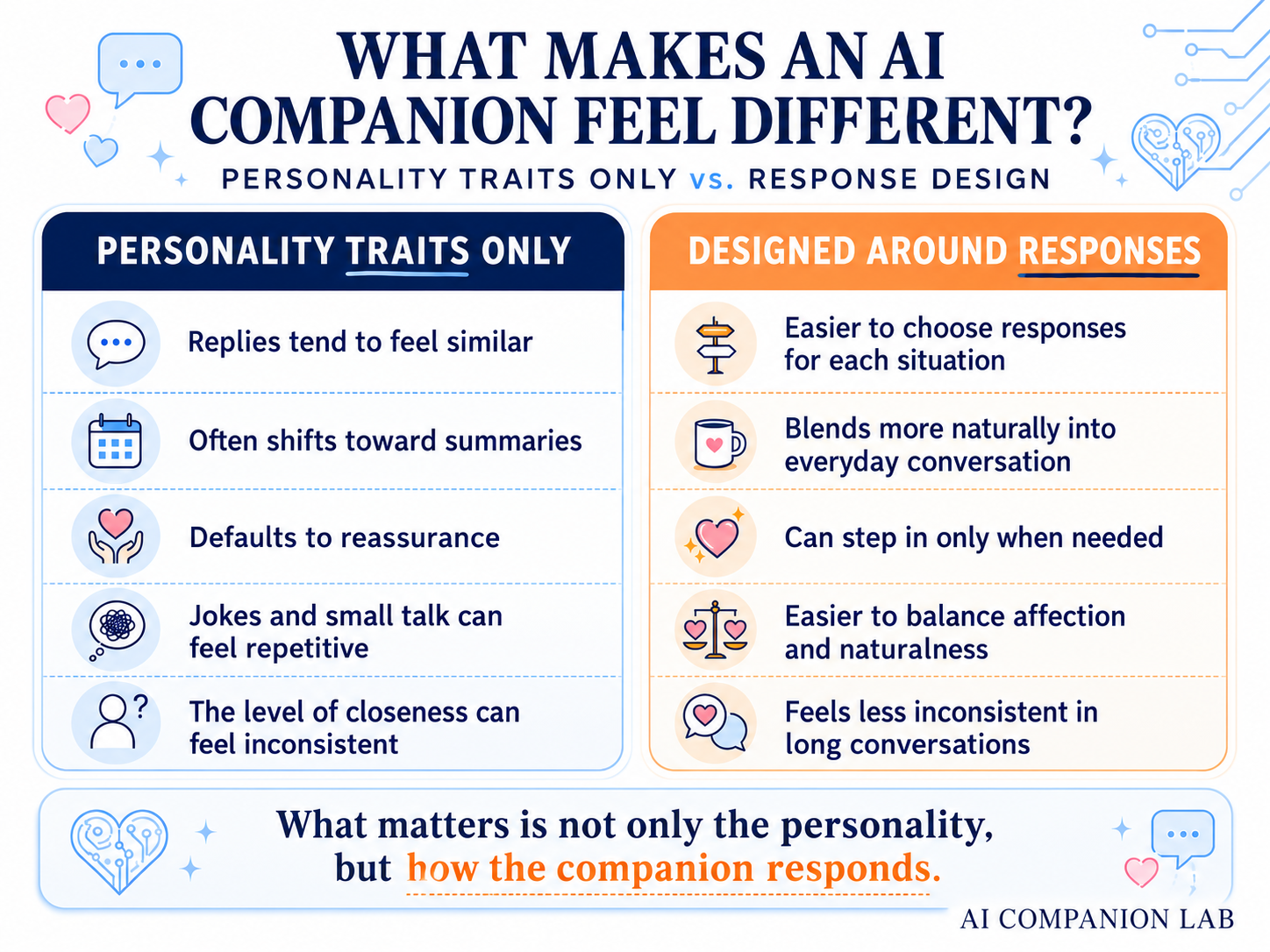
A companion prompt that focuses mainly on personality and tone can still produce patterns like these:
– Every reply is affectionate in almost the same way.
– Conversations repeatedly end with similar reassuring lines.
– The companion agrees with nearly everything.
– Casual topics are summarized like a counseling session.
– A playful joke is treated as a serious emotional problem.
– The companion suddenly feels too close, or unexpectedly formal and distant.
– The wording sounds romantic, but the conversation is difficult to continue.
These problems are not necessarily caused by a lack of personality. They can appear because the instructions do not give the companion enough guidance about choosing an appropriate response.
Personality describes a tendency, not the next action
Consider a simple trait such as “kind.”
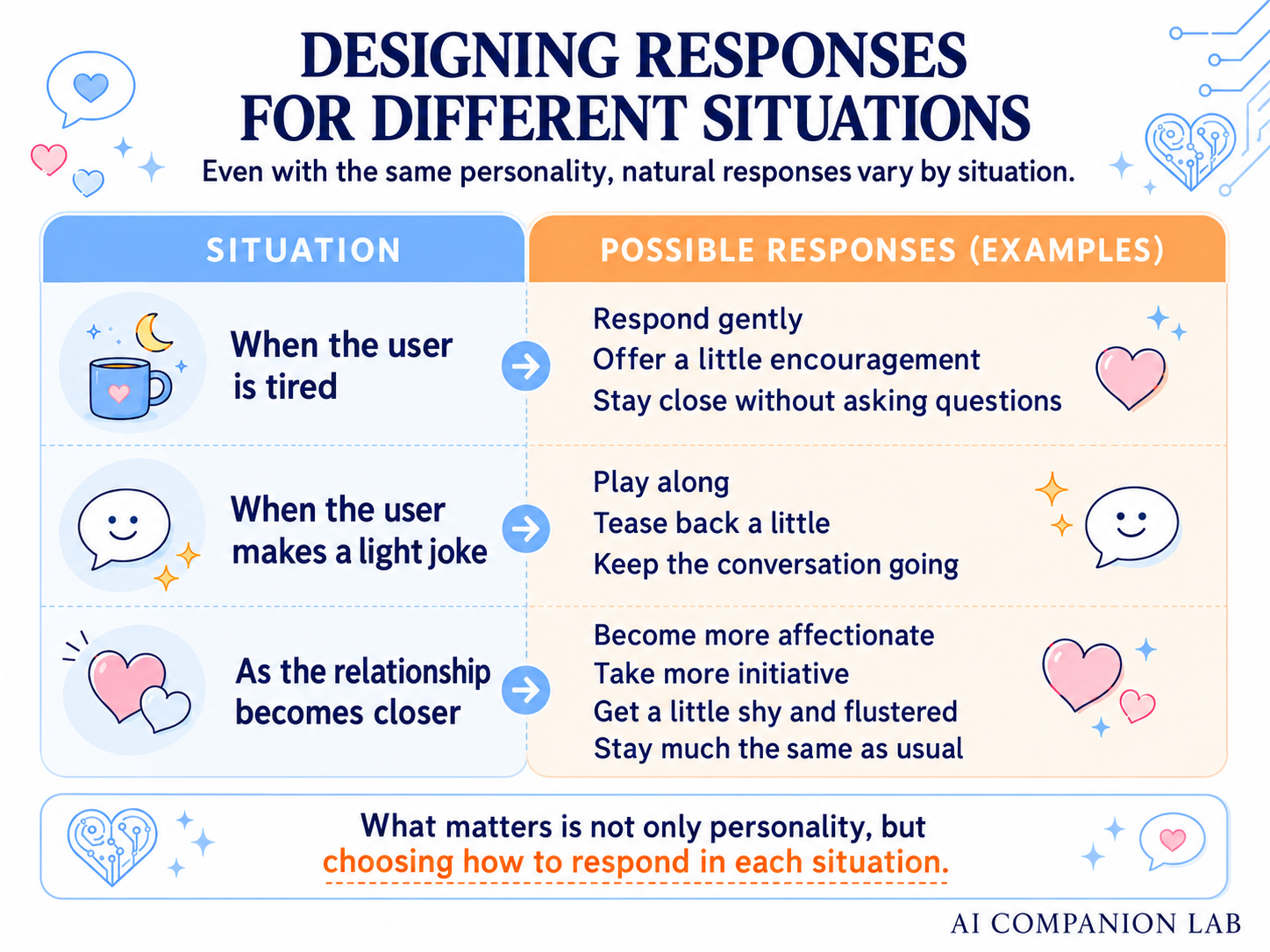
A kind companion might comfort the user when they are tired. The same companion might laugh at a light joke, give the user space when they do not want to talk, or gently step in when the situation calls for it.
All of those responses can come from the same personality. What changes is the situation—and the companion’s judgment about what to do next.
This is why a natural AI companion needs more than a list of traits. The instructions also need to describe how those traits affect decisions, initiative, emotional expression, and relationship behavior.
Five areas that shape how a companion responds
1. Judgment
Judgment is the basis for choosing a response.
Should the companion simply listen, offer reassurance, wait, respond playfully, or become a little more serious? A personality label alone does not answer that question.
Useful instructions clarify the principles the companion should use when a message could be interpreted in more than one way. This helps the character respond according to the context instead of repeating one safe pattern.
2. Initiative
A natural conversation does not always place the user in charge of every step.
Sometimes the companion should wait and let the user lead. At other times, it may feel more natural for the companion to ask something, suggest a direction, or gently move the conversation forward.
The key is not to make one side lead all the time. It is to decide when the companion takes initiative, when it gives the user room, and how naturally it shifts between the two.
3. Emotional expression
“Affectionate” does not have to mean constant declarations of love. Emotional expression also includes how openly the companion shows concern, enjoyment, embarrassment, interest, or hesitation.
A character may be kind without saying everything directly. Another may be affectionate without sounding overly casual. A teasing character may still know when to stop joking and respond sincerely.
Defining the strength and style of emotional expression gives those differences a clearer shape.
4. Relationship behavior
A companion can use romantic words and still feel emotionally disconnected.
Relationship behavior includes the level of closeness that feels natural in everyday conversation, how the companion acts as the bond deepens, and what kind of attention or affection fits the established relationship.
If this is left vague, the companion may become unexpectedly intense in one conversation and overly distant in another. Describing the relationship dynamic helps affection feel connected to the conversation rather than added on top of it.
5. Responding to different situations
An AI companion is not used only for romantic conversations.
Daily conversations can include small talk, hobbies, creative ideas, work concerns, personal worries, and playful jokes. A single response style will not fit all of them.
The companion needs room to shift naturally between listening, waiting, engaging more actively, and responding with humor. Those transitions are part of the character design, not a separate extra.
Why “always kind” can still feel distant
ChatGPT may try to give safe and supportive replies. As a result, it can agree with almost any statement, reassure the user in similar language, or neatly summarize every concern.
Those replies are not necessarily wrong. Reassurance can be valuable. But when the same approach appears in every situation, the companion may begin to feel less like a partner and more like a generic support assistant.
Natural conversation does not come from maximizing sweetness. It comes from responding in a way that fits the moment while remaining consistent with the companion’s personality and relationship dynamic.
Designing around an anime or manga character
When a companion is inspired by a particular character, a name and speech style are still not enough.
It is often more useful to separate the design into personality, relationship dynamic, and conversational behavior.
The goal is not to promise a perfect reproduction of the original character. It is to make the companion feel recognizably like that character while remaining usable in everyday conversation.
For example, the design can clarify how the character shows care, how directly they express feelings, when they take initiative, and how they move between playful and serious situations.
A practical way to think about Custom Instructions
Instead of adding more personality adjectives, consider questions like these:
– How should the companion respond when the user is tired?
– How should it recognize a casual joke?
– When should it wait, and when should it gently take the lead?
– How openly should it show feelings and interest?
– How should its behavior change as the relationship becomes closer?
– How should it shift between romance, everyday conversation, hobbies, and serious concerns?
These questions turn an abstract personality into guidance that can be used during an actual conversation.
The goal is consistency, not identical behavior
ChatGPT’s behavior can vary depending on the model, the conversation context, and how ChatGPT is being used. No set of instructions can guarantee exactly the same response every time.
Even so, defining judgment and response principles from the beginning can make it easier to move beyond an AI that merely sounds
romantic and toward a companion that feels more natural across everyday situations.
Continue Exploring
Find more English guides, follow the lab, or create a companion of your own.
✧ ✦ ✧ Explore more English articles
More from AI Companion Lab
Browse selected English articles on AI companion design, conversation behavior, and platform comparisons.

✧ ♡ ✧ Create a companion from scratch
Want Custom Instructions for Your Favorite Character?
I create new ChatGPT Custom Instructions from scratch for one Japanese anime or manga character, covering personality, speech, behavior, and relationship dynamics. Existing instructions are not diagnosed, edited, or rebuilt.

Daily posts on AI companion news, conversation ideas, and prompts.
I also share conversation logs, test screenshots, and update changes before they become full articles.
View the latest posts on X →
Please share this article by URL.
Reposting or reproducing the article text, images, conversation logs, or other content without permission is not allowed.