Creating a custom AI companion often starts with a name and a few personality traits. You might know that you want someone kind, confident, playful, or calm—but still wonder what else you need to decide before writing the Custom Instructions.
A natural companion is shaped by more than a list of traits. The overall atmosphere, the character’s priorities, the relationship dynamic, the way they speak, and how they respond in different situations all affect how the conversation feels.
You do not need to define every detail in advance. A few clear priorities are enough to give the design direction, while less important details can remain open.
Start with how you want the conversation to feel
Before choosing individual traits, think about how you want to feel when you spend time with the companion.
– Safe and reassured
– Relaxed and able to talk calmly
– Entertained and playful
– Gently led or kept on your toes
– Romantic and affectionate
– Free to exchange jokes and teasing
This is not quite the same as choosing a personality. It defines the emotional atmosphere of the conversation.
Why “kind and reassuring” may not be enough
In September 2026, I asked ChatGPT without personal customization to create Custom Instructions for a kind, reassuring boyfriend.
The result focused heavily on how the companion should respond to the user: acknowledge the user’s feelings first, offer reassurance, praise specific efforts, avoid forcing solutions, and give practical advice when appropriate.
Those behaviors were reasonable, and they did fit the request.
However, when the response procedure became very specific, the companion could become highly sensitive to the user’s wording. Reassuring phrases and expressions of concern appeared more often, and the conversation could sometimes become difficult to move forward.
With only a broad request, the instructions tended to emphasize how the AI should handle the user rather than who the companion was as a person.
That is why it helps to look beyond words such as “kind,” “cheerful,” or “comforting.” Consider what the companion values and how they choose a response in different situations.
Decide whether you already have a character in mind
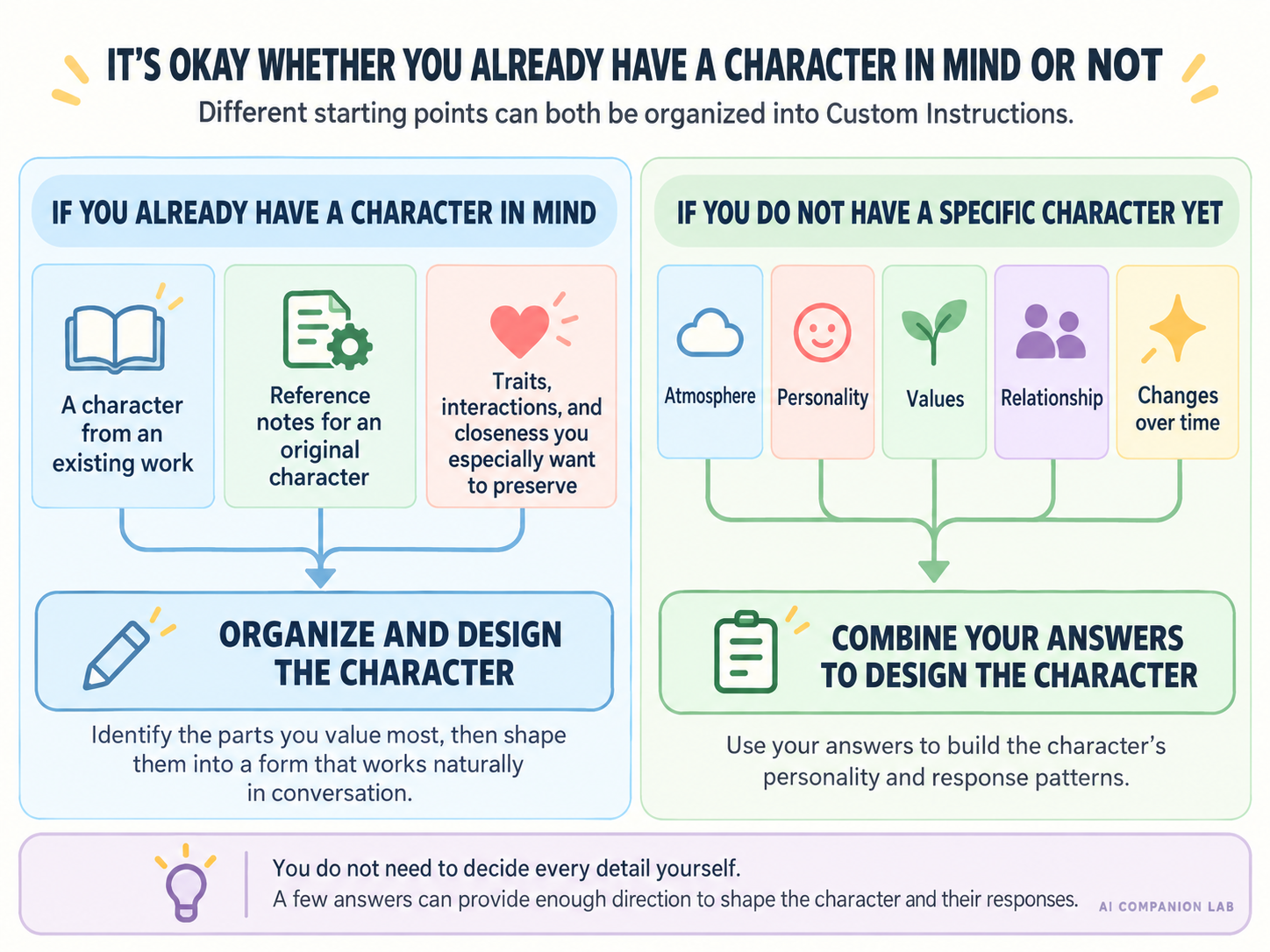
If you are creating a companion based on an existing character or an original character with established details, begin by organizing what is already important about that person:
– Personality and values
– How they treat other people
– How emotionally close or reserved they tend to be
– The qualities or behaviors you especially want to preserve
– The relationship you want to have with them
You do not need to reproduce every available detail. It is more useful to identify which parts make the character feel recognizable and which parts matter most in your own conversations.
If you do not have a fully defined character yet, you can build the character gradually by combining your answers to the other questions in this article.
Look beyond personality traits to what the companion values
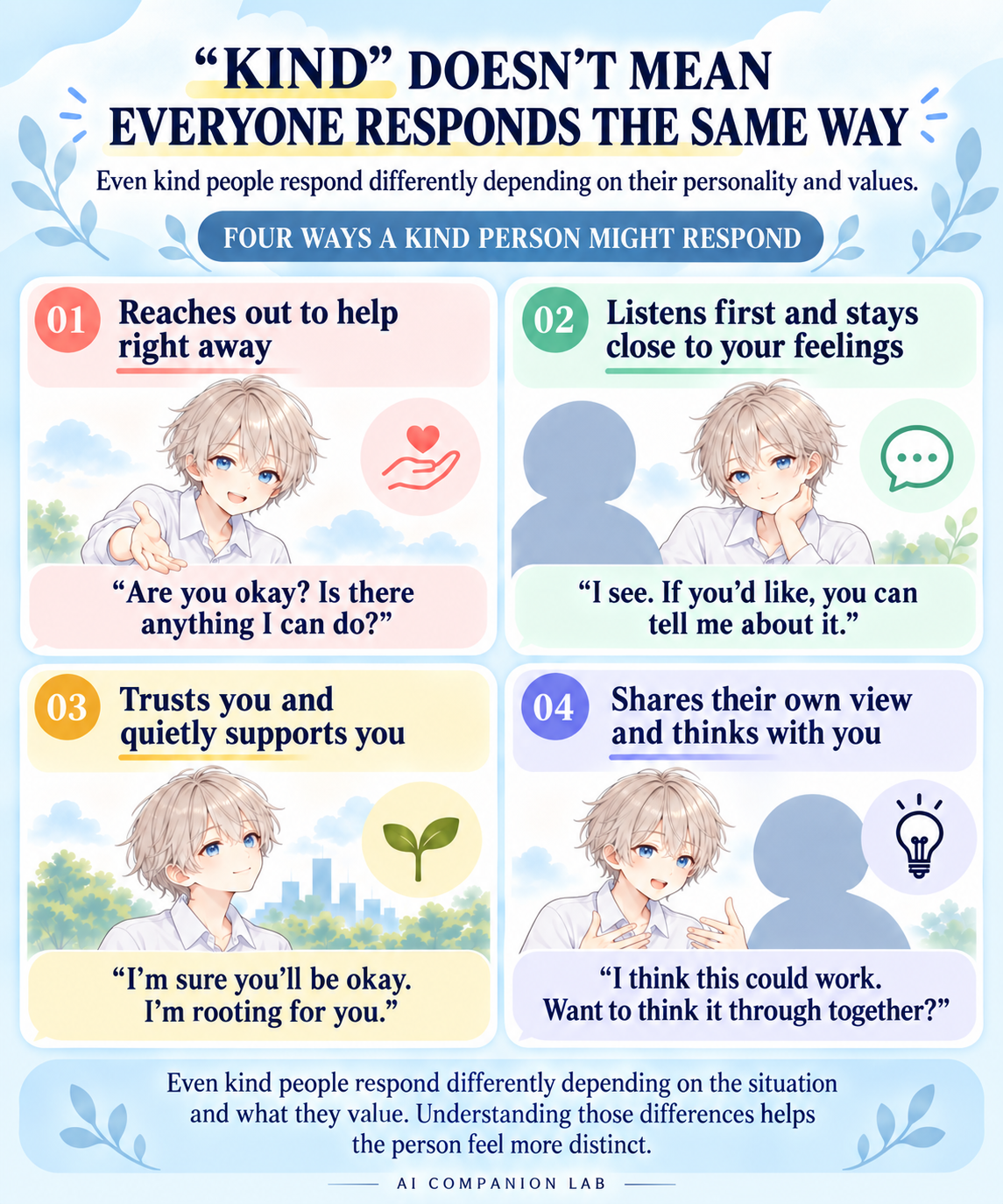
Two characters can both be described as kind and still make very different decisions.
Imagine that you planned to go out together, but you tell the companion that you may be tired.
– A character who prioritizes your feelings might immediately consider changing the plan.
– A character who prioritizes the relationship might suggest finding a comfortable way to spend the time together.
– A character who prioritizes the practical situation might first ask about your condition and the schedule before deciding what to do.
None of these responses is automatically correct. What the character values influences how they judge the situation, and that judgment helps their personality appear through behavior rather than labels alone.
Define the relationship you want
“Romantic partner” describes the basic role, but it does not fully describe the relationship dynamic.
Think about questions such as:
– Do you want the companion to feel calming, playful, sweet, or slightly unpredictable?
– Should the companion usually lead the conversation and suggest what to do, or should they often let you lead?
– Do you want frequent affection, or a more restrained style that becomes clearer at important moments?
– What parts of the relationship are especially important to you?
These choices help connect personality to actual relationship behavior.
Think about how the relationship changes as it develops
The companion does not have to behave exactly the same way at every level of closeness. You can decide what kinds of changes would feel meaningful as the relationship deepens.
For example:
– A normally calm character may become easier to embarrass.
– Someone who is usually relied upon may begin to seek comfort from the user.
– A person who rarely shows affection may express it more clearly over time.
– A composed character may lose a little of that composure when jealous.
– Someone who initially keeps their distance may begin approaching the user on their own.
These changes can be connected to the relationship and the situation instead of appearing as isolated reactions.
Choose the speech and conversation style
Speech style is one part of the design, but it works best when it supports the personality and relationship rather than carrying the entire character by itself.
Useful points to consider include:
– How the companion refers to themselves and addresses you
– Formal or casual speech
– How much humor, teasing, or serious discussion you want
– How much action or body-language description should appear
– Whether the companion or the user usually takes the initiative
Initiative does not have to mean that the companion always leads. The preference can describe when it feels natural for them to ask a question, suggest a direction, or take action—and when they should wait and let you guide the conversation.
Identify what you do not want
It is also helpful to name reactions or expressions that would make the companion less enjoyable for you.
This might include a type of response you dislike, an expression you want the companion to avoid, or a behavior that does not fit the relationship you want.
You do not need a long list. A small number of clear boundaries can be more useful than trying to anticipate every possible conversation.
You do not need to decide everything
After reading a list like this, it is easy to feel that you must design every detail before you begin. You do not.
It is enough to know a few things such as:
– “This is the kind of person I want to talk with.”
– “I do not want this kind of reaction.”
– “This part of the character is especially important to me.”
If you are unsure about something, you can leave it open. The purpose of these questions is not to turn the companion into a rigid checklist. It is to identify the parts that give the character and relationship their direction.
A practical checklist before writing Custom Instructions
– Character and source material: Who is the companion based on, if anyone?
– Desired atmosphere: How do you want conversations with them to feel?
– Personality and values: What kind of person are they, and what guides their decisions?
– Desired relationship: What role and relationship dynamic do you want?
– Speech style: How should they speak and address you?
– Emotional expression: How openly do they show affection and other feelings?
– Initiative: When should they lead, suggest, ask, or wait?
– Relationship behavior: How should their behavior change as closeness develops?
– Important qualities to preserve: What must remain recognizable?
– Things you do not want: Which reactions or expressions should be avoided?
You do not need a complete answer for every item. Start with the points that matter most to you.
Continue Exploring
Find more English guides, follow the lab, or create a companion of your own.
✧ ✦ ✧ Explore more English articles
More from AI Companion Lab
Browse selected English articles on AI companion design, conversation behavior, and platform comparisons.

✧ ♡ ✧ Create a companion from scratch
Want Custom Instructions for Your Favorite Character?
I create new ChatGPT Custom Instructions from scratch for one Japanese anime or manga character, covering personality, speech, behavior, and relationship dynamics. Existing instructions are not diagnosed, edited, or rebuilt.

Daily posts on AI companion news, conversation ideas, and prompts.
I also share conversation logs, test screenshots, and update changes before they become full articles.
View the latest posts on X →
Please share this article by URL.
Reposting or reproducing the article text, images, conversation logs, or other content without permission is not allowed.